

What Is a HEAVY DUTY DOOR?
A HEAVY DUTY DOOR is designed for environments where a standard door may not provide enough durability, structural strength, operational reliability, or protection. These doors are commonly specified for commercial, institutional, and industrial buildings where doors may be opened hundreds of times per day, exposed to equipment traffic, used in demanding environments, or expected to remain reliable over a long service life.
The term “heavy duty” does not describe one single door design. Depending on the project, it may refer to a reinforced steel door, industrial swing door, sliding door, impact-resistant door, insulated door, high-traffic access door, or a custom door system designed around specific operational requirements.
Key point: The right HEAVY DUTY DOOR should be selected according to the actual operating environment. A door used between warehouse zones may require different materials, hardware, sealing, and opening mechanisms than a door used in a clean production area, hospital corridor, or exterior loading zone.
When comparing products, buyers should therefore look beyond appearance and dimensions. Door leaf construction, frame reinforcement, hinges or rollers, locking hardware, surface finish, sealing, opening frequency, traffic type, and maintenance requirements can all affect long-term performance.
Where Are HEAVY DUTY DOORS Commonly Used?
HEAVY DUTY DOORS are used in locations where conventional light-duty doors may wear quickly or fail to meet operational demands. Because each industry has different requirements, the application should be identified before choosing the door configuration.
Factories and Production Facilities
Manufacturing environments may involve frequent personnel movement, carts, machinery, material transport, vibration, dust, moisture, or temperature changes. A HEAVY DUTY DOOR used in a factory may therefore require reinforced construction, durable hardware, easy-to-clean surfaces, and a design that can tolerate repeated operation.
Warehouses and Logistics Areas
Warehouse doors are often exposed to high traffic and material-handling activity. Depending on the opening location, buyers may need to consider impact resistance, visibility panels, opening speed, clearance, frame protection, and how easily staff can move through the doorway while carrying or transporting goods.
Commercial Buildings and Service Areas
Shopping centers, office buildings, hotels, kitchens, service corridors, back-of-house areas, and utility rooms may also require heavy-duty doors. In these locations, visual appearance may still matter, but durability, hardware quality, security, and ease of maintenance are often equally important.
Healthcare, Laboratory, and Controlled Environments
In healthcare or controlled environments, doors may need smooth surfaces, reliable closing action, cleanable materials, controlled access, special seals, or project-specific hygienic features. The door specification should be coordinated with the room function rather than selected only by thickness or weight.
Food Processing and Cold-Condition Areas
Food-processing areas may require doors that tolerate cleaning, humidity, temperature differences, frequent movement, and contact with carts or equipment. Materials, seals, finishes, and hardware should be selected with the actual sanitation and operating conditions in mind.
HEAVY DUTY DOOR Selection and Installation Process: 5 Steps
For first-time buyers, ordering a HEAVY DUTY DOOR can seem complicated because multiple technical details affect the final configuration. A structured selection process helps reduce specification errors and makes quotation comparison easier.
Step 1: Define the Door Location and Application
Start by identifying where the door will be installed and how the opening is used. Is it an interior or exterior opening? Will pedestrians, carts, forklifts, equipment, or goods regularly pass through it? Is the area dry, humid, dusty, hot, cold, or exposed to frequent cleaning? These details affect the door material and hardware specification.
Step 2: Confirm Opening Size and Site Conditions
Measure the opening carefully and identify the surrounding wall construction, floor condition, available clearance, frame location, and any nearby pipes, equipment, or structural limitations. Accurate dimensions help the supplier determine whether a standard configuration is suitable or whether a custom HEAVY DUTY DOOR is required.
Step 3: Select Door Construction and Hardware
Door leaf material, frame, hinges, rollers, handles, closers, locks, seals, protective plates, and viewing panels should be selected according to usage. High-frequency openings typically place more stress on hardware, so component quality becomes particularly important.
Step 4: Review the Quotation and Technical Scope
Before placing an order, compare more than the total price. Check whether the quotation includes the door leaf, frame, hardware, finish, accessories, installation, transport, site measurement, removal of the existing door, and any electrical or control components if applicable.
Step 5: Installation, Testing, and Handover
After installation, the door should be checked for alignment, smooth movement, closing action, locking, sealing, and interaction with surrounding equipment. Users should also understand basic cleaning, adjustment, and maintenance requirements before the project is completed.
How to Choose a HEAVY DUTY DOOR Supplier: 6 Important Checks
A suitable supplier should be able to explain why a particular configuration fits the project instead of simply providing a product catalog. Before ordering a HEAVY DUTY DOOR, evaluate the supplier using the following six points.
- Check whether the supplier understands the application.
A warehouse, hospital, factory, kitchen, and cold area may all require different door characteristics. The supplier should ask about actual usage before recommending a model. - Confirm whether custom dimensions are available.
Industrial openings are not always standard sizes. Ask whether the door leaf, frame, hardware position, viewing panel, and accessories can be customized when required. - Review material and hardware specifications.
Do not rely only on terms such as “heavy duty.” Ask what materials are used for the door leaf, frame, hinges, rollers, locks, surface finish, and other key components. - Make sure the quotation scope is clear.
A lower quotation may exclude site measurement, installation, transport, accessories, frame work, demolition, finishing, or special hardware. Compare quotation items line by line. - Ask about installation and after-sales support.
Door performance depends heavily on correct installation and adjustment. Confirm who performs the installation and what happens if alignment or hardware adjustment is required later. - Avoid selecting by price alone.
A HEAVY DUTY DOOR is normally expected to withstand demanding use. A cheaper option may not be economical if components wear quickly or the door requires repeated repair.
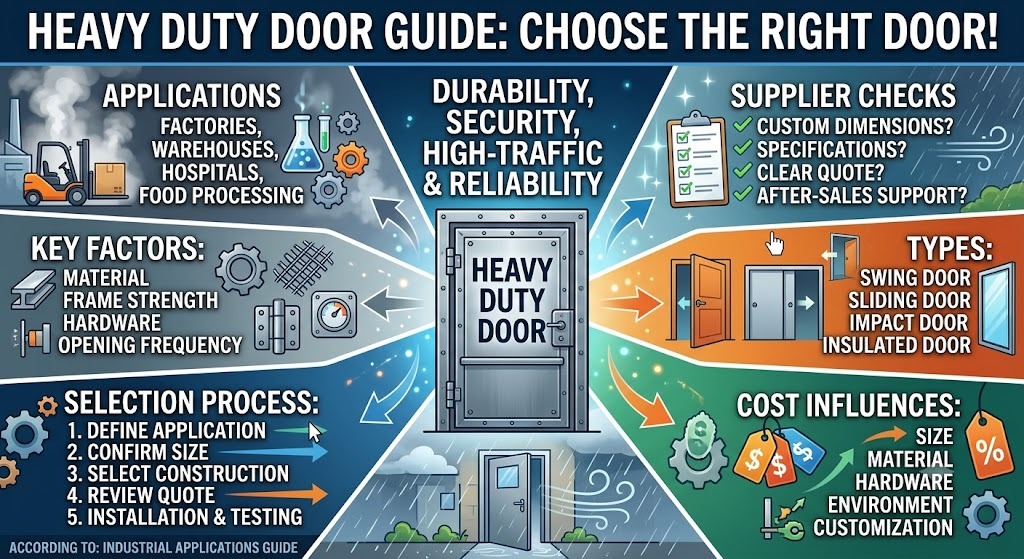
Different Types of HEAVY DUTY DOORS
There is no universal door type for every industrial or commercial project. The right HEAVY DUTY DOOR configuration depends on movement pattern, available space, environmental conditions, security needs, cleaning requirements, and the type of traffic using the opening.
| Door Type | Typical Characteristics | Common Applications |
|---|---|---|
| Heavy-Duty Swing Door | Simple operation, reinforced leaf and frame, multiple hardware options. | Factories, utility rooms, service corridors, commercial buildings. |
| Heavy-Duty Sliding Door | Useful where swing clearance is limited or a wide opening is required. | Warehouses, production areas, equipment access openings. |
| Impact-Resistant Door | Designed for environments where carts, trolleys, or equipment may contact the door. | Food processing, logistics, kitchens, service areas. |
| Insulated Heavy-Duty Door | Designed to reduce unwanted heat transfer between spaces when insulation is required. | Temperature-controlled rooms and selected industrial applications. |
| Custom Industrial Door | Configured around unusual dimensions, access requirements, hardware, materials, or project conditions. | Special production facilities, custom machinery access, non-standard openings. |
What Affects HEAVY DUTY DOOR Cost?
Buyers often ask, “How much does a HEAVY DUTY DOOR cost?” However, providing a single price without project information can be misleading. Cost can vary considerably depending on size, material, hardware, opening mechanism, surface finish, installation conditions, and custom requirements.
| Cost Factor | Why It Matters |
|---|---|
| Door Size | Larger openings may require more material, stronger frames, heavier hardware, or special support. |
| Door Material | Steel, stainless steel, composite, insulated panels, and specialized finishes can have different manufacturing costs. |
| Opening Mechanism | Swing, sliding, automatic, or special operating systems require different hardware and installation work. |
| Hardware | Hinges, rollers, locks, closers, handles, protective plates, and access-control components influence both performance and price. |
| Environmental Requirements | Humidity, cleaning, corrosion exposure, temperature differences, dust, and outdoor conditions may require upgraded materials or finishes. |
| Installation Conditions | Existing wall conditions, demolition, access limitations, equipment interference, and site location can affect labor requirements. |
| Customization | Special dimensions, viewing panels, seals, finishes, hardware positions, and other custom features can change the final quotation. |
Quotation tip: When comparing HEAVY DUTY DOOR prices, ask each supplier to quote against the same dimensions, materials, hardware, installation scope, and accessories. This makes it easier to identify whether a lower price reflects genuine efficiency or simply fewer included items.
What Information Should You Prepare Before Requesting a HEAVY DUTY DOOR Quote?
Providing complete information at the beginning can make the quotation process faster and more accurate. Before contacting a HEAVY DUTY DOOR supplier, prepare as much of the following information as possible.
- Approximate opening width and height.
- Interior or exterior installation location.
- Wall or frame condition around the opening.
- Expected daily opening frequency.
- Whether pedestrians, carts, forklifts, or equipment use the opening.
- Required door type, such as swing or sliding.
- Environmental conditions such as moisture, cleaning, dust, heat, or cold.
- Required lock, closer, handle, viewing panel, seal, or protective hardware.
- Photos of the current opening and surrounding area.
- Target installation schedule or project completion date.
If you do not yet know the exact technical specification, that does not necessarily prevent you from requesting a quote. A capable supplier should be able to review the application, identify missing information, and recommend options based on the project conditions.
HEAVY DUTY DOOR FAQ
Q1: What is a HEAVY DUTY DOOR?
A HEAVY DUTY DOOR is a door system designed for demanding applications where frequent use, durability, strength, security, impact resistance, environmental control, or long-term reliability is required.
Q2: Where can HEAVY DUTY DOORS be installed?
They are commonly used in factories, warehouses, logistics facilities, commercial buildings, service corridors, hospitals, laboratories, food-processing areas, utility rooms, and other high-traffic or demanding environments.
Q3: How do I choose the right HEAVY DUTY DOOR?
Start with the opening size, traffic type, opening frequency, environmental conditions, required material, hardware, security needs, and available installation space. The door should be selected according to the application rather than price alone.
Q4: Can a HEAVY DUTY DOOR be customized?
Depending on the manufacturer, customization may include door size, frame configuration, material, finish, viewing panels, handles, locks, seals, protective plates, hardware positions, and other project-specific features.
Q5: How much does a HEAVY DUTY DOOR cost?
The cost depends on dimensions, material, hardware, opening mechanism, environmental requirements, customization, installation conditions, and the scope included in the quotation. A project-specific quote is more useful than a generic price.
Q6: How long does HEAVY DUTY DOOR installation take?
Installation time varies according to door size, door type, site conditions, frame preparation, hardware, customization, and whether an existing door must be removed. The supplier should confirm the schedule after reviewing the site.
Q7: Do I need a site survey before ordering?
A site survey is often useful when dimensions, wall conditions, clearances, equipment interference, or installation details are uncertain. Accurate site information can reduce the risk of ordering the wrong configuration.
Q8: What maintenance does a HEAVY DUTY DOOR require?
Maintenance depends on the design, but common checks include hinges, rollers, fasteners, closers, locks, seals, alignment, surface condition, and smooth operation. High-frequency doors should be inspected regularly according to the manufacturer's recommendations.
Q9: Can I replace an existing standard door with a HEAVY DUTY DOOR?
In many projects this is possible, but the existing opening, frame, wall structure, floor condition, clearance, and hardware requirements should be checked first. Additional frame or structural work may sometimes be required.
Q10: What should I send when requesting a HEAVY DUTY DOOR quotation?
Provide the opening dimensions, installation location, photos, expected usage, traffic type, preferred door style, environmental conditions, required hardware, quantity, and target schedule. The more complete the information, the easier it is for the supplier to prepare an appropriate quotation.