

What Is a Facial Tissue Packing Machine?
A Facial Tissue Packing Machine is an industrial packaging system used to package stacks of folded facial tissue after the tissue converting process. Once the parent tissue roll has been folded, cut, counted, and stacked, the finished tissue must be protected and presented in a format suitable for storage, transport, retail display, or further carton packing.
Depending on the product design, a Facial Tissue Packing Machine may wrap individual soft packs with plastic film, insert tissue bundles into preformed bags, seal multiple packs together, or place finished tissue packs into cartons. Some factories use a single standalone machine, while higher-volume manufacturers often connect the packing equipment directly to the facial tissue folding machine to create an integrated automatic production line.
The purpose of automation is not simply to increase packaging speed. A properly matched system can also improve pack consistency, reduce manual handling, stabilize sealing quality, lower labor dependency, simplify production scheduling, and create a more repeatable finished product.
Key Point: The best Facial Tissue Packing Machine is not necessarily the fastest model. The correct machine is the one that matches your tissue size, pack style, required output, packaging material, upstream converting equipment, available floor space, and future production plan.
What Types of Facial Tissue Packing Machines Are Available?
Facial tissue products are sold in several packaging formats, so packaging equipment can vary significantly. Understanding the main machine categories helps buyers avoid purchasing equipment that is technically capable of running tissue products but poorly matched to the intended finished pack.
1. Single-Pack Facial Tissue Wrapping Machine
This type of machine wraps an individual stack of facial tissues in flexible packaging film. It is commonly used for soft-pack facial tissues. The machine typically performs feeding, film forming, wrapping, sealing, and cutting in a continuous sequence.
When comparing single-pack wrappers, buyers should pay attention to the supported tissue stack dimensions, pack height range, film width, sealing method, automatic feeding design, changeover procedure, and synchronization with the upstream tissue folder.
2. Multi-Pack Bagging Machine
A multi-pack system combines several finished tissue packs into one larger retail or transport bag. For example, a manufacturer may sell facial tissues in bundles of several individual soft packs. The bagging machine groups the required quantity, forms or opens the outer bag, inserts the packs, and seals the package.
3. Carton Packing Machine
Carton packing equipment is used when facial tissues are supplied in paperboard boxes rather than flexible soft packs. Depending on the production design, the machine may erect cartons, insert the tissue stack, close the carton, apply adhesive, and discharge the completed box.
4. Automatic Integrated Packaging Line
High-output tissue manufacturers may require an integrated line connecting folding, cutting, conveying, wrapping, multi-packing, inspection, coding, and case packing. Automation between processes reduces manual transfer and can help keep production flow more consistent.
| Machine Type | Main Function | Typical Application | Main Selection Focus |
|---|---|---|---|
| Single-Pack Wrapper | Wraps one tissue stack | Soft-pack facial tissue | Pack size, film, speed, sealing |
| Multi-Pack Bagger | Groups several packs | Retail bundle packs | Bundle pattern and bag dimensions |
| Cartoning Machine | Packs tissue into cartons | Boxed facial tissue | Carton size, insertion method, closing system |
| Integrated Line | Connects multiple processes | High-volume production | Line balance, automation and compatibility |
First-Time Purchasing Process: 5 Steps for Selecting a Facial Tissue Packing Machine
Buyers purchasing tissue packaging equipment for the first time should prepare production information before requesting quotations. A clear specification makes it easier for a machine supplier to recommend an appropriate configuration and reduces the risk of costly modifications after installation.
Step 1: Define Your Finished Tissue Product
Start with the finished product rather than the machine. Prepare the tissue length, width, folded size, number of sheets, stack height, number of plies, package dimensions, and desired pack appearance. If several SKUs will run on the same equipment, provide the minimum and maximum dimensions for each format.
Step 2: Confirm the Required Output
Determine the realistic production target per minute, hour, or shift. Do not select a machine based only on the highest advertised mechanical speed. Actual production output can be affected by product size, film properties, operator experience, upstream machine performance, product changeovers, and stoppages.
Step 3: Define the Packaging Material and Pack Style
Provide information about the packaging film, bag, carton, label, tear opening, printing registration, or other pack features. Packaging material characteristics can affect sealing temperature, tension control, feeding accuracy, and finished appearance.
Step 4: Review Factory Layout and Existing Equipment
Measure the available floor space and confirm the direction of product flow. If the Facial Tissue Packing Machine will connect to an existing folder, cutter, conveyor, printer, checkweigher, or case packer, the supplier should understand the interface requirements before machine design is finalized.
Step 5: Request a Technical Proposal and Test
A useful quotation should contain more than a price. Ask for machine configuration, supported pack range, utility requirements, layout, operating requirements, optional modules, spare parts information, warranty terms, installation scope, and training arrangements. Whenever possible, send actual tissue and packaging materials for a test run or sample evaluation.
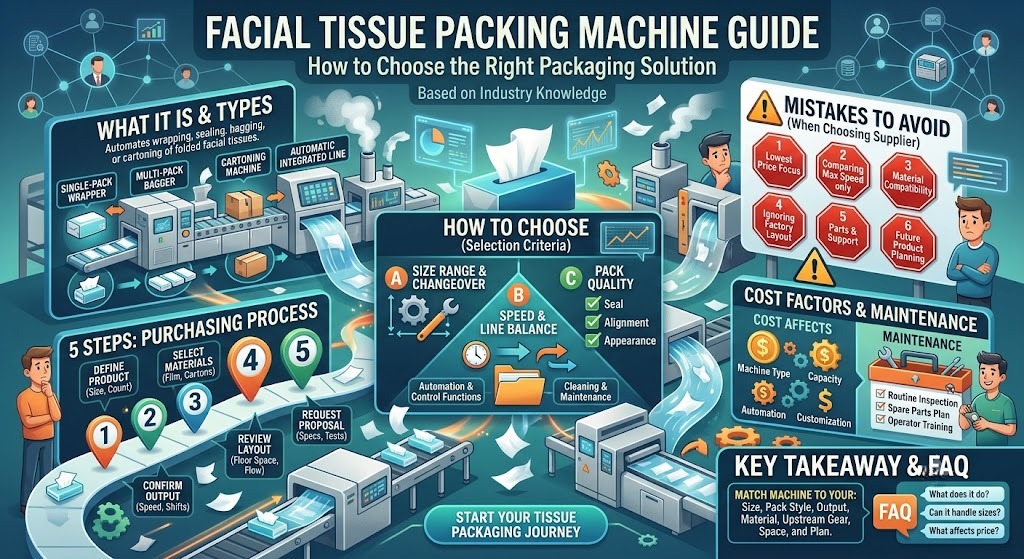
How to Choose the Right Facial Tissue Packing Machine
Check the Supported Product Size Range
A packaging machine has physical limits for product width, length, and height. If your business produces several tissue formats, make sure all planned sizes fall within the machine's practical operating range. Also ask how long product changeovers take and whether adjustment requires tools.
Match Machine Speed to the Upstream Tissue Folder
An extremely fast packaging machine provides limited value if the folding and cutting section cannot supply tissue stacks at a comparable rate. Production lines should be designed as balanced systems. A supplier should evaluate both nominal output and stable continuous production.
Evaluate Packaging Quality, Not Only Speed
Finished packages should have consistent sealing, acceptable film tension, correct alignment, clean edges, and stable dimensions. For printed film, registration accuracy may also be important. Poor wrapping quality can create waste even when the machine itself operates quickly.
Consider Automation and Control Functions
Depending on the application, useful features may include touch-screen control, recipe storage, servo motion control, automatic film tracking, photoelectric registration, fault alarms, production counting, automatic feeding, safety guarding, and integration signals for upstream and downstream machines.
Ask About Changeover and Cleaning
Factories with many product SKUs should pay particular attention to changeover time. A machine that runs efficiently but requires lengthy adjustment between products may reduce overall plant productivity. Accessible machine surfaces and easy cleaning also make routine operation more practical.
6 Mistakes to Avoid When Choosing a Facial Tissue Packing Machine Supplier
- Choosing only by the lowest quotation. A lower purchase price may exclude important feeding systems, controls, spare parts, installation, or support.
- Comparing only maximum machine speed. Ask for stable production speed using a product similar to your actual tissue format.
- Not confirming material compatibility. Packaging film and tissue characteristics should be tested whenever practical.
- Ignoring factory layout. The machine must physically fit the production space while allowing access for operators, maintenance, material loading, and cleaning.
- Not reviewing spare parts and after-sales support. Consumable and wear components should be identified before purchase.
- Failing to plan for future SKUs. If new tissue sizes, pack counts, or package styles are likely to be introduced, discuss them with the supplier before finalizing the machine.
What Affects Facial Tissue Packing Machine Cost?
There is no meaningful universal price for a Facial Tissue Packing Machine because equipment specifications vary widely. A standalone wrapper for a standard tissue size and a customized integrated high-speed packaging line are fundamentally different projects. For this reason, buyers should compare quotations according to configuration rather than treating machine price as a single number.
| Cost Factor | Why It Matters |
|---|---|
| Machine Type | Single wrapping, bagging, cartoning, and complete-line systems require different mechanisms. |
| Production Capacity | Higher-output systems may require faster motion control, more automation, and stronger feeding coordination. |
| Product Range | A wider size range or multiple SKUs may require adjustable or customized components. |
| Packaging Material | Different films, bags, and cartons can require different feeding and sealing systems. |
| Automation Level | Automatic feeding, coding, inspection, multi-packing, or case packing increases system complexity. |
| Customization | Special layouts, interfaces, pack styles, controls, or safety requirements may require additional engineering. |
| Installation and Service | Training, commissioning, travel, spare parts, and service scope may affect total project cost. |
When requesting a quotation, provide detailed product information and ask suppliers to list included and optional items separately. This makes quotations easier to compare and helps prevent unexpected costs later in the project.
How to Plan a Complete Facial Tissue Packaging Line
Manufacturers planning higher production volumes should consider the entire packaging flow rather than evaluating the Facial Tissue Packing Machine as an isolated unit. Bottlenecks can occur wherever product is transferred, counted, grouped, inspected, or manually handled.
A typical production flow may include tissue folding, cutting, stack transfer, individual wrapping or cartoning, coding, inspection, multi-pack bundling, conveying, case packing, and pallet handling. Not every factory needs all of these stages, but the relationship between them should be considered early in the project.
Useful information to prepare for a line-layout discussion:
- Current tissue folding machine model and output
- Finished tissue and package dimensions
- Number of planned product SKUs
- Required packs per minute or packs per shift
- Available factory dimensions and ceiling height
- Operator access and material-loading direction
- Required downstream bundling or case-packing method
Maintenance and Production Stability: What Should Buyers Check?
Long-term machine value depends heavily on maintenance accessibility and parts support. A packaging line that is difficult to clean, adjust, or troubleshoot can create unnecessary downtime even if its initial performance is strong.
Routine Inspection
Operators should follow the manufacturer's maintenance schedule for cleaning, lubrication, fastener inspection, conveyor checks, sealing components, sensors, belts, bearings, and other wear items. Maintenance frequency depends on production hours and the machine design.
Spare Parts Planning
Before commissioning, ask the supplier which parts should be stocked locally. Keeping commonly replaced components available can reduce downtime if a failure occurs. It is also useful to clarify part identification, ordering procedures, and expected service support.
Operator Training
Training should cover startup, shutdown, size changeover, film loading, alarm handling, routine cleaning, basic troubleshooting, and safe operating procedures. Clear documentation helps the production team maintain more consistent machine performance.
Facial Tissue Packing Machine FAQ
Q1: What does a Facial Tissue Packing Machine do?
A Facial Tissue Packing Machine automates the packaging of folded facial tissue stacks. Depending on the machine configuration, it can wrap individual soft packs, group several packs into larger bags, insert tissue into cartons, or connect with other equipment in an automatic packaging line.
Q2: What product information should I provide before requesting a quotation?
You should provide the folded tissue dimensions, sheet count, stack height, number of plies, finished package dimensions, packaging material, required output, product samples if available, and information about upstream or downstream equipment.
Q3: Can one Facial Tissue Packing Machine handle different tissue sizes?
Many machines can accommodate several product sizes within a specified adjustment range. However, the minimum and maximum dimensions should be confirmed with the supplier, and buyers should ask how the size changeover is performed.
Q4: How fast can a Facial Tissue Packing Machine operate?
Operating speed depends on the machine model, tissue size, package format, packaging material, upstream feeding conditions, and automation level. Buyers should compare stable production output rather than relying only on a maximum advertised speed.
Q5: Can the packing machine connect directly to a facial tissue folding machine?
Yes, compatible equipment can often be integrated through conveyors, automatic feeding systems, and control signals. The supplier should review the output, product transfer method, machine height, line direction, and control interface before confirming the connection.
Q6: What affects the price of a Facial Tissue Packing Machine?
Price is influenced by machine type, production capacity, supported size range, automation level, packaging material, optional modules, customization, installation requirements, spare parts, and after-sales service scope.
Q7: How much factory space is required?
Required space depends on whether you are installing a standalone wrapper or a complete packaging line. In addition to the machine footprint, sufficient space should be reserved for operators, packaging material loading, maintenance, cleaning, product flow, and upstream or downstream equipment.
Q8: Do I need to book or arrange a machine test before purchasing?
When practical, a test using your actual tissue samples and packaging materials is recommended. Testing can help verify feeding, sealing, finished-pack appearance, compatibility, and realistic operating conditions before the final machine specification is approved.
Q9: How long does installation and commissioning take?
Installation and commissioning time varies according to machine complexity, factory preparation, line integration, electrical and utility connections, product testing, and operator training. A standalone machine is generally simpler to commission than a customized integrated packaging line.
Q10: What should I check when comparing Facial Tissue Packing Machine suppliers?
Compare supported product specifications, stable production capability, machine configuration, automation functions, changeover method, packaging quality, safety design, spare parts availability, documentation, training, warranty terms, and after-sales technical support.