

What Are Polycarbonate Roof Screws?
Polycarbonate roof screws are fasteners designed or selected specifically for installing corrugated, profiled, or multiwall polycarbonate roofing sheets. Although they may resemble ordinary roofing screws, a complete polycarbonate fastening system often includes a corrosion-resistant screw, a wide sealing washer, an EPDM gasket, a spacer, or a cutting component that creates sufficient clearance around the fixing point.
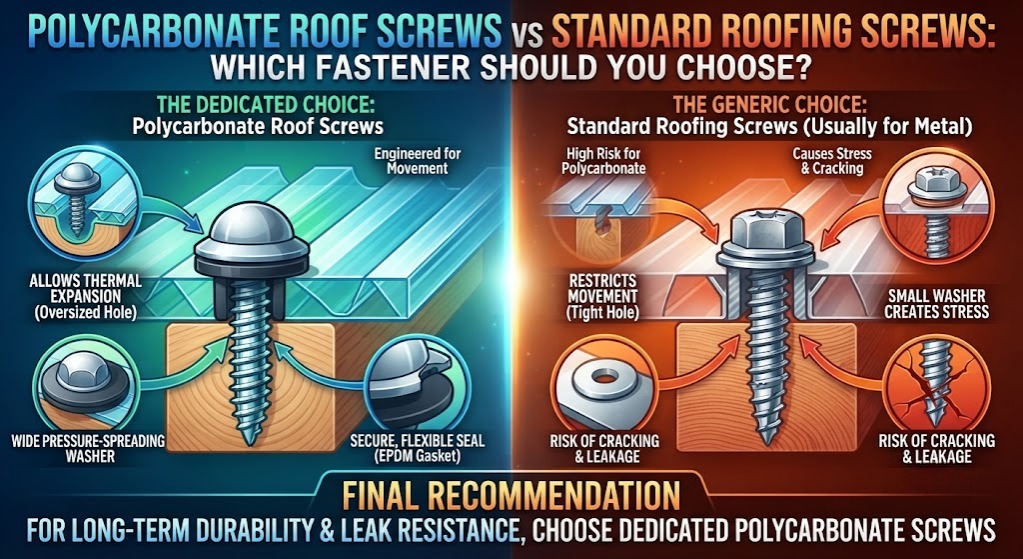
These details matter because polycarbonate behaves differently from steel roofing. Polycarbonate expands when temperatures rise and contracts when temperatures fall. The fixing system must therefore hold the panel securely without locking it so tightly that normal thermal movement creates excessive stress. Manufacturers commonly recommend oversized fixing holes, suitable gaskets, corrosion-resistant screws, and careful tightening for this reason.
A screw that is perfectly acceptable for a metal roof may not automatically be suitable for polycarbonate. If the screw head is too small, the washer is too rigid, or the fastener is overtightened, the sheet can become distorted around the fixing point. Over time, this may contribute to cracking, enlarged holes, water entry, or visible stress marks.
Practical rule: The correct fastener is not simply the strongest screw. It is the screw-and-washer combination that secures the sheet while still allowing the roof panel to expand and contract.
Polycarbonate Roof Screws vs Standard Roofing Screws: What Is the Difference?
The main difference is not necessarily the screw thread itself. The important difference is how the complete fixing controls pressure, seals the hole, and accommodates sheet movement.
Dedicated Polycarbonate Roof Screws
Dedicated polycarbonate roof screws are usually supplied as part of a fastening system. Depending on the brand, the system may include an EPDM sealing washer, a dome washer, a weather seal, a spacer, or a cutting wing that creates an expansion hole during installation. Some purpose-designed fasteners can create the necessary clearance without a separate pre-drilling step, although this depends entirely on the product and the manufacturer’s instructions. Laserlite, for example, describes a proprietary fixing that cuts an expansion hole while the screw is installed.
Standard Roofing Screws
Standard roofing screws are commonly designed for metal roofing, flashing, cladding, timber, or steel purlins. They may include a bonded washer, but the washer diameter and compression characteristics may not match the requirements of a polycarbonate panel. A standard screw may still be acceptable in certain installations, but only when combined with the correct washer, expansion clearance, screw length, and manufacturer-approved installation method.
In other words, using an ordinary roofing screw is not automatically wrong, but using one without understanding polycarbonate movement is risky. A fastener that clamps a steel panel securely may clamp a polycarbonate sheet too tightly.
Large Comparison Table: Polycarbonate Roof Screws vs Standard Roofing Screws
| Item | Polycarbonate Roof Screws | Standard Roofing Screws | Best For |
|---|---|---|---|
| Primary purpose | Designed or configured for polycarbonate roofing sheets | Usually designed for metal roofing, cladding, or general construction | Dedicated screws are safer for polycarbonate-specific work |
| Thermal movement | Usually accommodates movement through oversized holes, flexible seals, or proprietary cutters | May restrict movement unless the installer creates proper clearance | Roofs exposed to wide temperature changes |
| Washer design | Often uses a wide EPDM or purpose-designed weather seal | May use a smaller bonded washer intended for metal sheets | Installations where leak resistance is a priority |
| Risk of overtightening | Reduced when the fixing includes a spacer or controlled compression design | Higher if the installer drives the screw as tightly as a metal roofing screw | DIY installers and first-time users |
| Pre-drilling | Some systems require oversized pre-drilled holes; others cut clearance automatically | Usually requires the installer to pre-drill according to the panel guide | Projects where installation speed matters |
| Frame compatibility | Versions may be available for timber or metal purlins | Wide variety available, but the washer system must still be compatible | Installers who know the exact frame material |
| Corrosion resistance | Normally selected for long-term exterior exposure | Varies widely by coating, grade, and environment | Coastal, humid, or high-rainfall locations |
| Installation convenience | Usually easier to match with a branded roofing system | Requires more installer judgment and component matching | Homeowners seeking a simpler purchasing decision |
| Purchase price | Often costs more per fastener | Often cheaper and widely available | Budget buyers must compare total roof risk, not unit price alone |
| Long-term suitability | Usually the more reliable option when installed correctly | Can work, but only with correct detailing and approval | Permanent patios, canopies, carports, and covered walkways |
Why Dedicated Polycarbonate Fasteners Matter
They Allow for Thermal Expansion and Contraction
Polycarbonate sheets continuously respond to temperature. During hot weather, a long panel can expand along its length. During cooler conditions, it contracts. If the fixing hole is too tight around the screw shaft, the panel cannot move freely. The resulting stress may show up as buckling, noise, distortion, cracking, or fatigue around the fixing point.
Palram specifically advises pre-drilling oversized holes, avoiding overtightening, and using flexible EPDM gaskets with corrosion-resistant fasteners. It also distinguishes between self-tapping screws for timber purlins and self-drilling screws for metal purlins.
They Spread Pressure Across a Wider Area
A wide washer distributes clamping pressure across more of the sheet. This reduces the concentration of force directly beneath the screw head. A small washer can create a high-pressure point, particularly when the installer drives the screw too deeply.
They Improve Weather Sealing
A suitable EPDM washer creates a weather-resistant seal while remaining flexible enough to respond to small movements. The washer should be compressed enough to seal, but not crushed or spread excessively. When the rubber bulges dramatically beyond the washer, the fastener is often too tight.
They Reduce Installation Guesswork
Matching branded polycarbonate roof screws with the selected roofing system can simplify the installation. Some manufacturers design panels, closures, washers, and screws as a complete system. Palram, for example, recommends using its corrugated roofing components together to support proper installation and performance.
Three Buying Scenarios: Which Option Fits Your Project?
Scenario 1: Best Choice for Beginners
First-time installers should generally choose manufacturer-recommended polycarbonate roof screws or a complete fixing kit. This reduces the need to independently match screw diameter, washer size, gasket material, thread type, and expansion clearance. A dedicated system does not remove the need to read the installation guide, but it reduces the number of decisions that can go wrong.
Scenario 2: Best Choice for Budget-Focused Buyers
Budget-focused buyers may consider compatible standard roofing screws, but only after confirming the required screw type, washer diameter, sealing material, corrosion protection, fixing location, and hole clearance. A cheaper screw may save money initially, but replacing cracked panels or repairing leaks costs far more than the difference between generic and purpose-designed fasteners.
Scenario 3: Best Choice for Performance and Efficiency
Contractors, property managers, and homeowners who value long-term performance should use a fixing system approved for the exact panel profile and supporting structure. Purpose-designed fasteners are especially valuable for permanent patios, commercial canopies, greenhouses, carports, pergolas, and areas exposed to frequent rain or strong temperature changes.
Choosing Polycarbonate Roof Screws for Timber and Metal Frames
Timber Purlins
Timber framing generally requires a screw with a coarse thread that can develop reliable holding power in wood. The screw must be long enough to pass through the roofing profile, washer assembly, and any relevant spacer before achieving sufficient embedment in sound timber.
Avoid assuming that one screw length fits every corrugated profile. A deep roofing profile may require a longer fastener than a low-profile corrugated sheet, particularly when the screw is installed through the crest.
Metal Purlins
Steel or aluminum framing normally requires a self-drilling or metal-compatible screw. The drill point and thread must suit the thickness and type of the supporting member. Using a timber screw in metal framing can result in poor penetration, stripped threads, or inadequate holding strength.
The screw coating or material should also match the exposure environment. Humid, industrial, coastal, and chemically aggressive locations may require greater corrosion resistance than a sheltered inland patio.
Important: High-wind, cyclonic, elevated, or engineered roofing applications should not be treated as ordinary DIY installations. Some manufacturers specifically require additional guidance for high roofs or high-wind zones.
Polycarbonate Roof Screws Cost and Quantity Considerations
The cost of polycarbonate roof screws depends on the screw material, corrosion-resistant coating, washer size, gasket design, screw length, package quantity, and whether the fastener includes a proprietary expansion-hole cutter or spacer.
Instead of comparing only the price per screw, calculate the total installed cost. Include the number of fasteners required, compatible washers, drill bits, replacement pieces, labor time, and the potential cost of correcting leaks or damaged panels.
Fastener quantity should follow the panel manufacturer’s fixing pattern rather than a universal rule. The required number may change according to panel profile, purlin spacing, roof location, edge zones, overlaps, wind exposure, and local building requirements. Laserlite, for example, publishes different screw spacing guidance for end purlins and intermediate purlins.
Buying too few fasteners can lead installers to increase spacing beyond the recommended pattern. Buying an exact number without spare pieces can also interrupt work if a washer is damaged or a screw head strips. A modest allowance for replacements is usually practical.
How to Install Polycarbonate Roof Screws Correctly
Step 1: Read the Panel-Specific Instructions
Do not rely only on general advice. Corrugated, trapezoidal, multiwall, and standing-seam polycarbonate systems may use different fixing methods. Confirm the recommended screw location, support spacing, hole size, side lap, end lap, and washer type for the exact product.
Step 2: Confirm the Supporting Structure
Identify whether the purlins are timber, light-gauge steel, structural steel, or another material. Select a screw with the correct thread and drill point for that substrate.
Step 3: Mark the Fixing Locations
Follow the manufacturer’s fixing pattern. Keep screw lines straight and avoid placing fixings too close to unsupported edges unless the installation guide specifically requires them there.
Step 4: Pre-Drill Oversized Holes When Required
When the selected fixing does not automatically create expansion clearance, pre-drill holes larger than the screw shaft according to the panel instructions. Palram warns that skipping this clearance can contribute to warped or distorted panels.
Step 5: Keep the Screw Perpendicular
Drive the screw square to the fixing surface. An angled screw can pull the washer unevenly, distort the panel, and leave one side of the hole insufficiently sealed.
Step 6: Tighten Only Until Sealed
Stop when the washer makes full, even contact and creates a seal. Do not continue driving until the panel visibly dimples. Overtightening can distort the sheet and place excessive stress around the hole.
Step 7: Inspect the Completed Roof
Check for uneven washers, missing fixings, cracked sheet edges, distorted corrugations, loose overlaps, and fasteners that were driven too deeply. Correcting a problem immediately is easier than finding it after the first heavy rain.
Six Mistakes to Avoid When Buying or Installing Polycarbonate Roof Screws
- Using nails instead of screws: Nails can damage rigid polycarbonate and prevent the sheet from moving correctly. Palram advises against using nails for its rigid PVC and polycarbonate panels.
- Choosing screws by price alone: A low-cost screw with an unsuitable washer can create a much more expensive roof problem.
- Skipping expansion clearance: A tight hole around the screw shaft can restrict normal thermal movement.
- Overtightening the washer: Excessive torque can crush the seal, dimple the sheet, and create stress around the fixing.
- Using the wrong screw for the frame: Timber and metal purlins generally require different threads and drilling points.
- Ignoring high-wind requirements: Standard fixing patterns may not be suitable for exposed, elevated, or engineered structures.
How to Select the Right Polycarbonate Roof Screws
Before requesting a quote or adding fasteners to your cart, collect the following information:
- The exact brand and profile of the polycarbonate roofing sheet
- The sheet thickness and corrugation depth
- Whether the support structure is timber or metal
- The thickness of the metal purlin, where applicable
- The recommended fixing position on the panel profile
- The required washer or gasket diameter
- Whether oversized pre-drilling is required
- The expected weather and corrosion exposure
- The roof height, wind exposure, and engineering requirements
- The manufacturer’s required fastener spacing
When comparing products, ask suppliers whether the screw is approved for polycarbonate roofing, whether it is suitable for your frame material, and whether the package includes compatible washers. It is also useful to confirm whether the screw creates its own expansion hole or requires pre-drilling.
Final Recommendation: Which Roofing Screw Is Better?
For most residential and commercial polycarbonate roofing projects, dedicated polycarbonate roof screws are the safer and more straightforward choice. Their washers, sealing components, and installation design are more likely to match the movement and weatherproofing requirements of the sheet.
Standard roofing screws may be suitable when the panel manufacturer allows them and when they are combined with the correct washer, gasket, expansion hole, thread type, and corrosion protection. However, they demand more technical judgment from the buyer and installer.
Beginners should choose a complete manufacturer-recommended fixing system. Budget-focused buyers should compare total installation risk rather than screw price alone. Buyers who prioritize durability, installation efficiency, and leak resistance should select purpose-designed polycarbonate fasteners matched to the exact panel and supporting structure.
Next step: Before ordering polycarbonate roof screws, provide the supplier with your panel profile, sheet thickness, support material, roof dimensions, and exposure conditions. This allows the supplier or installer to recommend the correct screw length, thread, washer, and quantity.