

Pneumatic Grease Pump Problem? Do These 3 Things First
A pneumatic grease pump is widely used in workshops, factories, fleet maintenance facilities, construction equipment service areas, and centralized lubrication systems because compressed air can move high-viscosity grease efficiently. When the pump suddenly stops delivering grease, runs continuously, loses pressure, or operates irregularly, the problem does not always mean that the entire pump has failed.
Before disassembling the pump, begin with the easiest external checks. Pneumatic lubrication equipment depends on several conditions working together: adequate compressed air, a clear grease supply path, properly sealed fittings, and a pump assembly that can cycle without obstruction. A problem in any one of these areas can create similar symptoms.
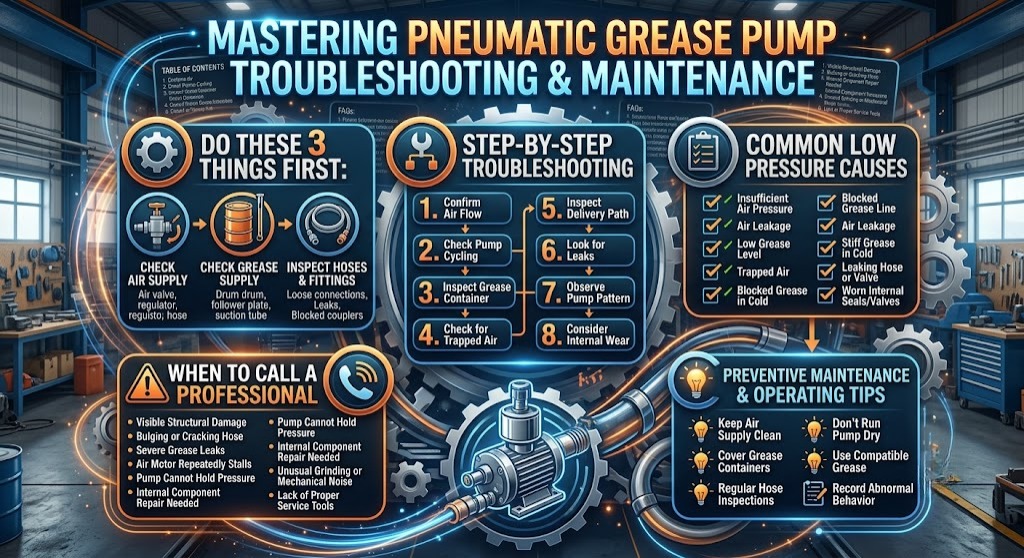
Do these 3 things first:
- Check the compressed air supply: Confirm that the air valve is open, the regulator is set correctly for the equipment, and the hose is not kinked, leaking, or disconnected.
- Check the grease supply: Make sure the drum or container is not empty and that the follower plate, suction tube, and grease inlet are properly positioned.
- Inspect hoses and fittings: Look for loose connections, damaged hoses, blocked couplers, leaks, or dried grease restricting flow.
If the pneumatic grease pump still does not operate normally after these checks, continue with a systematic troubleshooting process. The goal is to identify whether the fault is on the air side, grease side, delivery line, control components, or the internal pump mechanism.
Common Pneumatic Grease Pump Problems and Causes
Different failures can produce similar symptoms, so troubleshooting should begin by observing exactly what the pneumatic grease pump is doing. Is the air motor completely silent? Does it cycle rapidly without delivering grease? Does grease come out slowly? Does the pump stop under load? These clues help narrow the problem.
| Possible Cause | How to Identify It | Recommended Action |
|---|---|---|
| Insufficient air supply | Pump is slow, weak, or does not cycle consistently. | Check regulator setting, air valve, compressor capacity, hose condition, and air leaks. |
| Empty or low grease container | Pump cycles but little or no grease reaches the outlet. | Refill or replace the grease container and prime the system if required. |
| Air trapped in the grease line | Intermittent delivery, spitting grease, or irregular pressure. | Bleed or prime the system according to the equipment procedure. |
| Blocked hose, valve, coupler, or grease gun | Pump builds pressure but grease does not reach the application point. | Inspect the delivery path section by section and clean or replace blocked components. |
| Grease too stiff for current conditions | Pump becomes slow, especially in cold environments, or stalls under load. | Confirm that the grease grade and operating temperature are suitable for the system. |
| Follower plate not seated correctly | Pump draws air or loses prime even though grease remains in the container. | Reposition the follower plate and remove trapped air around the grease surface. |
| Loose fitting or grease-side leak | Visible grease leakage, pressure loss, or slow pressure buildup. | Inspect connections and replace damaged seals, fittings, or hoses as needed. |
| Internal seal, valve, or pump wear | External checks are normal, but the pump still cycles poorly or cannot maintain pressure. | Arrange internal inspection and service using the correct repair procedure. |
Step-by-Step Pneumatic Grease Pump Troubleshooting
The most effective way to troubleshoot a pneumatic grease pump is to start with the external supply conditions and move gradually toward the pump itself. Do not begin by dismantling the air motor or grease piston. In many cases, the problem is located outside the main pump assembly.
Step 1: Confirm the Air Supply
Verify that compressed air is reaching the pump. Check the shutoff valve, regulator, air hose, quick-connect fittings, and filter-regulator assembly if one is installed. Listen for obvious air leakage. A hose may look connected while a damaged coupler or restricted fitting prevents adequate airflow.
Do not simply increase air pressure to force the pump to operate. The correct operating air pressure depends on the pump design and manufacturer specification. Excessive pressure can damage seals, accelerate wear, or create unsafe conditions. Use the equipment's approved operating range.
Step 2: Check Whether the Pump Is Cycling
Observe the pump after air is supplied. If there is no movement or sound, the problem may be related to the air supply, air valve, air motor, or an internal mechanical obstruction. If the pump cycles rapidly but does not deliver grease, the problem is more likely on the grease supply side.
A pump that cycles continuously can also indicate that grease is escaping somewhere downstream or that the pump is drawing air instead of grease. Continuous cycling should not automatically be treated as normal operation.
Step 3: Inspect the Grease Container and Suction Area
Make sure there is enough grease in the drum, pail, or reservoir. If a follower plate is used, verify that it is sitting correctly on the grease surface and moving downward as grease is consumed. Cavities or air pockets around the pump inlet can cause the pump to lose prime even when the container still contains grease.
Also confirm that the grease is suitable for the equipment and current operating temperature. Grease becomes more difficult to pump as viscosity increases, particularly in colder environments.
Step 4: Check for Air in the Grease System
Air trapped in the suction path or delivery line can cause irregular grease flow, pressure fluctuations, or repeated loss of prime. This commonly occurs after changing a grease drum, opening the system, or allowing the container to run empty.
If the system requires bleeding or priming, follow the pump manufacturer's recommended procedure. Do not loosen high-pressure grease fittings while the system is pressurized.
Step 5: Inspect the Delivery Hose, Coupler, and Grease Gun
If the pump appears to build pressure but grease does not reach the lubrication point, inspect the downstream path. A blocked grease gun, damaged swivel, clogged coupler, collapsed hose, or contaminated fitting can stop flow even when the pump itself is working.
Check the system one section at a time. This prevents unnecessary pump disassembly when the actual restriction is located at the end of the delivery line.
Step 6: Look for Air and Grease Leaks
Air leaks reduce the power available to operate the pump. Grease leaks reduce delivered pressure and waste lubricant. Inspect threaded fittings, hose ends, seals, swivels, control valves, and connections around the pump.
Do not ignore small leaks simply because the pump still operates. A minor leak can develop into pressure loss, contamination, hose failure, or an unsafe work area.
Step 7: Observe Pump Speed and Operating Pattern
A healthy pneumatic grease pump should operate in a reasonably consistent pattern for the load being applied. Extremely rapid cycling may indicate lack of grease, air entering the suction path, or an open downstream path. Very slow cycling can indicate insufficient air supply, excessive grease resistance, a restriction, or internal wear.
Comparing the current operating pattern with the pump's normal behavior is often more useful than judging noise alone.
Step 8: Consider Internal Pump Wear Only After External Checks
If the air supply, grease supply, hoses, fittings, couplers, and system priming are all normal but the pump still cannot build or maintain pressure, internal components may require inspection. Possible areas include seals, check valves, piston components, air-valve components, or other wear parts.
At this stage, use the correct service manual or contact a qualified technician. Pneumatic grease equipment can store pressure, so disassembly without depressurizing and following the correct procedure can be hazardous.
Why a Pneumatic Grease Pump Has Low or No Pressure
One of the most common complaints is that the pneumatic grease pump runs but does not generate enough grease pressure. This symptom can come from both the air side and the grease side, so replacing the pump immediately is usually premature.
Common low-pressure causes include:
- Insufficient compressed air volume or pressure.
- Air leakage before the pump.
- An almost empty grease container.
- Air trapped around the pump inlet.
- A partially blocked grease line.
- Grease that is difficult to pump at the current temperature.
- A leaking hose, swivel, fitting, or control valve.
- Internal seal or valve wear.
If pressure falls gradually over time rather than disappearing suddenly, pay particular attention to leakage, contamination, seal wear, and increasing restrictions in the grease path. If pressure suddenly disappears after replacing a grease container, loss of prime or trapped air should be checked early in the troubleshooting process.
When to Stop Troubleshooting and Call a Professional
Basic checks such as inspecting the air hose, grease level, fittings, and external leaks are appropriate for many operators. Internal repair is different. Pneumatic lubrication systems may contain compressed air and high-pressure grease, and incorrect service procedures can create injury risk or damage expensive equipment.
Stop troubleshooting and arrange professional inspection if:
- The pump has visible structural damage.
- A hose is bulging, cracked, or leaking under pressure.
- Grease is leaking from an area that normally remains sealed.
- The air motor repeatedly stalls despite a confirmed air supply.
- The pump cannot hold pressure after all external leaks have been eliminated.
- Internal components need to be removed or rebuilt.
- The pump produces unusual impact, grinding, or mechanical noises.
- You do not have the correct service procedure, replacement parts, or pressure-control equipment.
Before servicing any pressurized lubrication equipment, isolate the air supply and release system pressure according to the manufacturer's instructions. Never assume that shutting off the compressor automatically removes pressure from the grease line.
Pneumatic Grease Pump Maintenance and Operating Tips
Many pneumatic grease pump problems can be reduced through consistent maintenance. Grease systems operate in environments where dust, moisture, metal particles, old lubricant, and damaged fittings can all affect reliability. Keeping both the air side and grease side clean is therefore important.
Keep the Compressed Air Supply Clean
Water, contamination, and poor air quality can shorten the service life of pneumatic components. Drain the air system as required and maintain filters, regulators, and lubricating devices according to the equipment design.
Keep Grease Containers Covered and Clean
Contamination introduced during drum changes can travel through the pump and eventually block valves, couplers, or lubrication points. Clean the top of the grease container and pump components before transferring the pump into a new drum.
Inspect Hoses and Fittings Regularly
Grease hoses operate under significant pressure and should be treated as wear items. Inspect them for cuts, abrasion, swelling, hardening, damaged reinforcement, or leakage. Replace damaged components rather than attempting temporary repairs that may not safely withstand operating pressure.
Do Not Run the Pump Dry
Allowing the grease container to empty completely can introduce air into the system and cause the pump to cycle rapidly. Monitor grease levels and replace containers before the pump begins repeatedly drawing air.
Use Grease Compatible With the Application
Not every grease behaves the same way under pressure or temperature changes. Before changing lubricant type or grade, verify that it is suitable for both the lubrication point and the pumping equipment. Mixing incompatible greases may also create consistency or performance problems.
Record Abnormal Operating Behavior
Changes in cycling speed, noise, grease consumption, pressure stability, or leakage can provide early warning of a developing problem. Recording when the symptom first appeared, what maintenance was recently performed, and whether a grease drum was changed can make diagnosis faster.
Pneumatic Grease Pump FAQ
Q1: Why is my pneumatic grease pump running but not pumping grease?
The grease container may be empty, the pump may have lost prime, air may be trapped at the inlet, the follower plate may not be seated correctly, or the grease delivery path may be blocked.
Q2: Why does a pneumatic grease pump cycle very fast?
Rapid cycling can occur when the pump is not picking up grease, the container is empty, air is entering the suction side, or grease is escaping through an open or leaking downstream path.
Q3: Why does my pneumatic grease pump have low pressure?
Low pressure may be caused by insufficient air supply, an air leak, a grease-side leak, a partial blockage, difficult-to-pump grease, trapped air, or worn internal seals or valves.
Q4: Can cold weather affect a pneumatic grease pump?
Yes. Grease can become more resistant to flow at lower temperatures, which increases pumping resistance. Confirm that the selected lubricant and equipment are suitable for the operating temperature.
Q5: Why does the pneumatic grease pump stop while pumping?
The pump may be experiencing insufficient air supply, excessive grease resistance, a blocked delivery line, a closed valve, or an internal mechanical problem. Check external restrictions before considering internal repair.
Q6: How do I know if the grease hose is blocked?
A blockage is possible when the pump builds pressure but little or no grease reaches the outlet. Inspect the hose, coupler, swivel, grease gun, and fittings in sections after safely releasing system pressure.
Q7: Should I increase air pressure if the grease pump is slow?
Do not increase air pressure beyond the equipment's specified operating range. First check for restrictions, air leaks, grease condition, blocked components, and other causes of slow operation.
Q8: Why does air get into a pneumatic grease pump?
Air can enter when the grease container runs empty, during a drum change, when the follower plate is not seated properly, or when an air pocket forms around the pump inlet.
Q9: How often should a pneumatic grease pump be inspected?
Inspection frequency depends on duty cycle, working environment, grease type, and manufacturer recommendations. Hoses, fittings, air components, leaks, and operating behavior should be checked regularly as part of preventive maintenance.
Q10: When should a pneumatic grease pump be professionally repaired?
Professional repair is recommended when the pump has internal leakage, repeated stalling, structural damage, unusual mechanical noise, inability to hold pressure, or a suspected internal seal, valve, piston, or air-motor problem.